Every Disagreement Is the Same Disagreement
146 years of House roll-call votes: American politics was often this divided, but it has never been this one-dimensional. The second axis of conflict is dead, and that changes how everything else works.
John Kinson 6 min read
Take every House roll-call vote since 1879 and ask a simple question: how well can you predict each member’s vote knowing only a single number about them — their position on one left-right axis? DW-NOMINATE, the standard method in political science, estimates those positions from the votes themselves. I re-ran the classification on every Congress from 1879 to 2025 — 35,141 roll calls, 13.3 million individual votes: for each roll call, predict members’ votes from their first-dimension score alone, then from their first two dimensions, and track what the second dimension adds. None of the individual facts below are new to political science — Poole and Rosenthal documented the second dimension’s collapse decades ago, and Voteview curates the data that makes checking possible. The contribution is re-running the classification end to end and putting the pieces side by side.
Findings
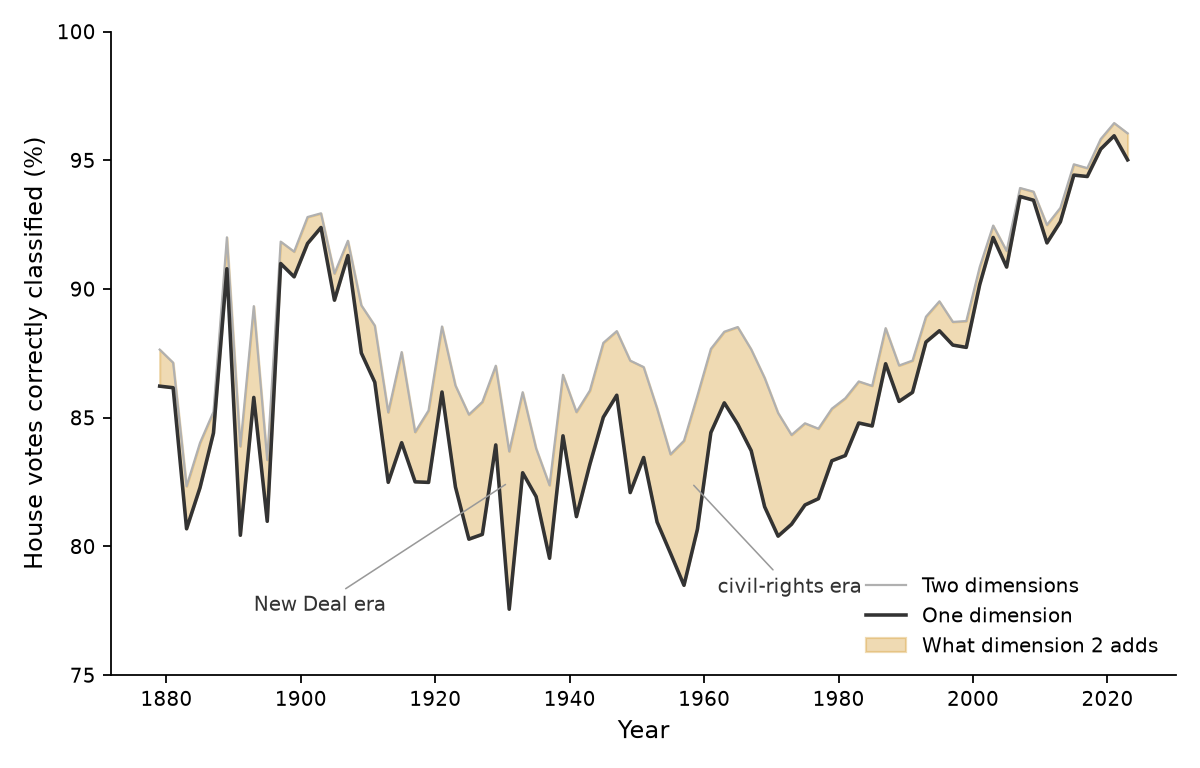
- One number now predicts 95% of votes. A single coordinate classified 96% of individual voting decisions in the 2021–22 Congress and 95% in the latest — the two highest values in 146 years, against 78–86% for most of the 20th century. On the harder test, proportional reduction in error over just guessing the majority, one dimension now eliminates 87–88% of baseline errors; in the mid-century Congress it managed about 43%.
- The second dimension is dead. For a century it mattered episodically — about 3.5 points of accuracy in the populist 1890s and the progressive 1910s, and 5–6 points from the New Deal realignment through the civil-rights era (peak: 6.1 in 1931, 5.6 in 1957). Since 1993 it has never exceeded 1.1 points, and since 1997 it has averaged 0.6.
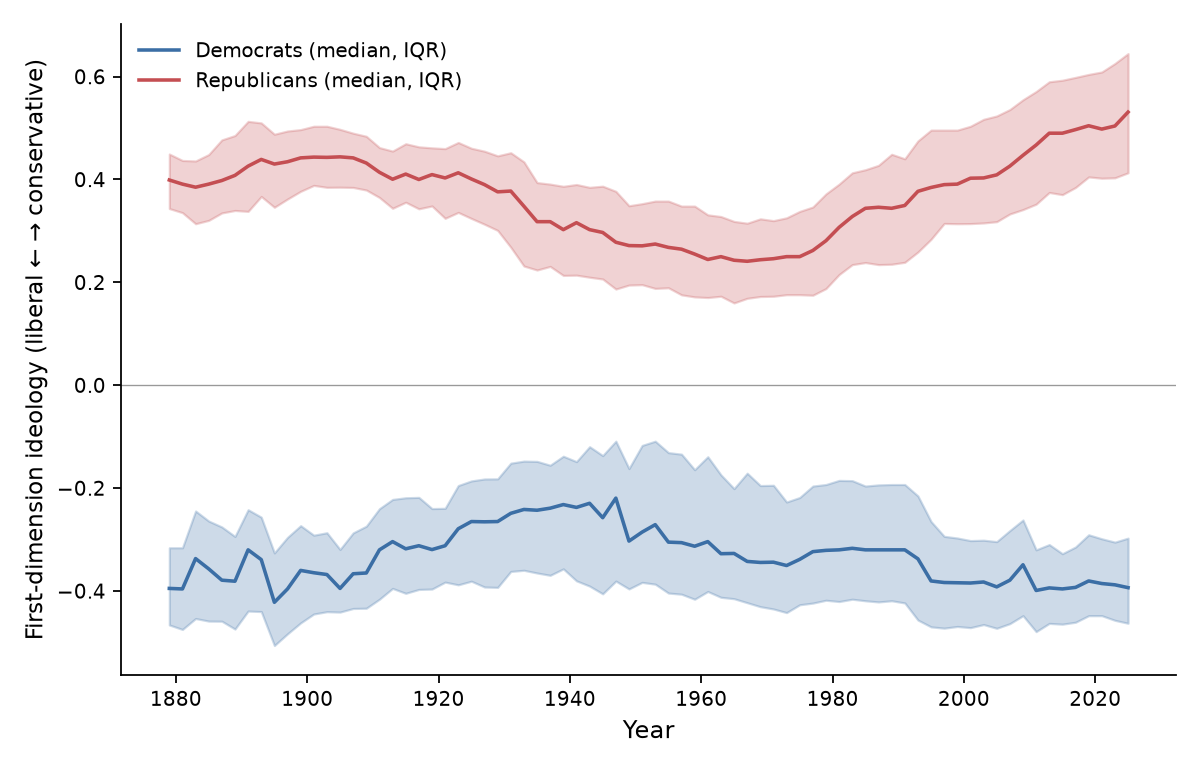
- The division is at a record, but division isn’t the new part. The gap between party medians (0.89) is the widest ever measured — yet the Gilded Age ran at 0.79 with zero overlap between the parties. America has been this divided before.
- The “bipartisan golden age” was a second war, not peace. Party overlap peaked in 1967 — precisely when the second dimension was near its peak. Mid-century moderation wasn’t consensus; it was race cutting across the economic axis, scrambling both parties. When that conflict collapsed into the main axis, the overlap went with it: effectively zero since the 1990s, exactly zero since the mid-2000s.
What it means
The folk story says Americans learned to disagree more. The data say something more specific: all disagreements became the same disagreement. Through most of the country’s history there were at least two live conflicts at once — economics and sectionalism, economics and populism, economics and race — and the second one repeatedly cut across the first, forcing coalitions that didn’t match the main axis. A politician could be your ally on one fight and your opponent on the other. That cross-pressure is what compromise brokers were made of.
What has never existed before the last three decades is a politics where the second conflict simply isn’t there. When one coordinate predicts everything, knowing someone’s position on any issue predicts their position on every issue — so new issues don’t create new coalitions, they get absorbed into the existing axis. The data here are elite behavior; the same sorting has been documented in the public, looser but moving the same direction. That is why subjects with no inherent left-right content — a virus, an electric car company, a social media platform — polarize within months of arriving. The axis is the only sorting machine available, and it sorts everything.
It also reframes the nostalgia. The mid-century Congress everyone misses wasn’t gentler; it contained a brutal second conflict whose cross-cutting coalitions merely looked like moderation. Wishing for that overlap back is wishing for a second axis of division — and the last one was race. Britain ran the experiment recently: Brexit was a genuine second dimension, it cross-cut both parties for five years, and nobody experienced it as moderation.
Method, briefly
Member coordinates and roll-call votes from Voteview (public, no registration). Every Congress, House, 1879–2025; near-unanimous roll calls (minority under 2.5%) excluded. Per roll call, two logistic classifiers on members’ DW-NOMINATE coordinates — dimension 1 alone versus dimensions 1+2 — scored in-sample, aggregated across every member-vote in each Congress; reported both as raw accuracy and as proportional reduction in error over the majority baseline. Robustness: because the modern floor is heavy with procedural party-line votes, the modern series was re-run on substantive votes only (passage, amendments, conference reports, overrides) — one-dimension accuracy stays above 90% and the trend is unchanged, so procedure isn’t driving the result. Party separation computed from all Congresses’ first-dimension scores: medians, interquartile ranges, histogram overlap.
Caveats
- This measures elite behavior — Congress, not the public. Mass sorting is documented but looser; the leap from floor votes to “why Tesla polarized” runs through that literature, not these data.
- NOMINATE scores come from votes under agenda control: leaders choose what reaches the floor, so some one-dimensionality may reflect what is allowed to be voted on, not what members believe. The substantive-only check limits but does not eliminate this.
- Comparing coordinates across 146 years leans on NOMINATE’s identifying assumptions; the within-era trends are more robust than any single cross-century comparison.
- In-sample accuracy flatters both models equally; the gap is the finding.
- The latest Congress’s gap (1.0 point) is the highest since 1995 — small, but if intra-party conflict is becoming a real second dimension, this is where it would first appear. Worth re-running in two years; the script is one command.
The practical upshot: when you see a new topic polarize instantly, you are not watching people reason to opposite conclusions. You are watching the sorting machine work — and it is the only machine left.