An Englishman in America
On scale, culture, and what it actually feels like to move from one English-speaking country to the other one.
John Kinson 10 min read
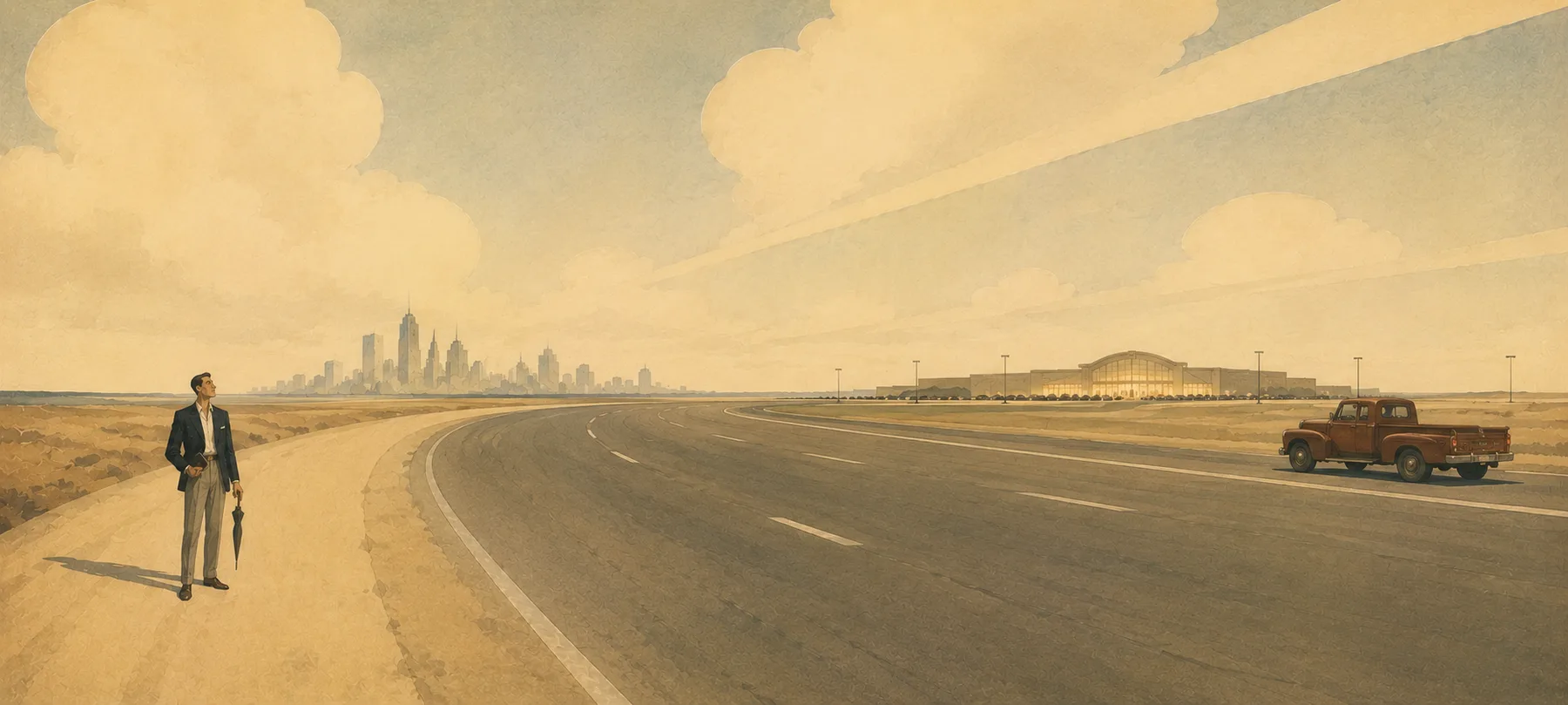
The first thing you notice about America is the scale, which is also the second, third, and fourth thing you notice about America.
The roads are larger. The distances are larger. The salaries are larger. The refrigerators are larger. The portions are larger. Even the administrative systems seem to operate at a scale slightly beyond what a British person instinctively considers reasonable.
After a while, though, you begin to notice that the scale is not merely physical. It is psychological.
The strange thing about America, to an English person, is that it is almost the same and then suddenly not. The language is almost the same. The food is almost the same. The buildings are almost the same. And then you walk into a Walmart for the first time and you understand that a Walmart is not a bigger version of a Tesco. It is a different kind of place altogether, closer to an indoor town that has been coerced into selling groceries and guns.
Ambition, without the irony
In Britain, ambition often has to be smuggled in. You don’t tend to say you want to be successful; you say you’d quite like to give something a go. You don’t tend to say you want to be more well off; you make a small face about the gas bill and hope the implication is understood. Ambition, where it exists, is often wrapped in enough layers of irony, modesty, and class anxiety that by the time it reaches the surface it can look almost like its opposite, which is sometimes the point.
In America, ambition is more often just there. People are more likely to say what they want. They say it without flinching, and they often assume you are going to say what you want back. A nice house, a business, a family, a degree of influence. These are presented as things one might simply set about acquiring, the way an English person might set about getting a slightly better umbrella.
The effect of this, on a certain kind of English person, is almost vertiginous. You begin to notice that a great deal of the apparatus you had been using to manage your own ambition, the irony, the deflection, the slight allergy to wanting things openly, was not, as you had assumed, a personality trait. It was a cultural climate. Move climates, and the apparatus feels less necessary. It can also, awkwardly, stop being charming.
A country pointed forward
The other thing you notice, which takes longer to put into words, is that America is pointed in a different direction in time than Britain is.
In Britain, you often locate yourself by where you have come from. The county, the school, the accent, the particular street, for some, the long inheritance of who your family was and what they did. The country is full of physical reminders that other people were here first: Roman walls, fourteenth-century pubs, churches older than the United States itself. The past is not just a subject in Britain. It is a substrate. You are walking on it.
In America, the visible past is much thinner on the ground. A house built in the 1960s is considered old. The bits of America that count as historic are, by British standards, almost embarrassingly recent. And yet you can still see the older English inheritance everywhere if you look for it. In the language. In the legal structures. In the religious cadence. In the assumption, baked into the founding documents, that government is something to be argued with on principle, which is one of the most English things about America even though it is now read as the most American.
But the orientation is different. Britain tends to look backward by default; America tends to look forward. The British dream, if there is one, often centers on preservation: the cottage, the pension, the country garden, the quiet retirement. The American dream, by contrast, is more often about something not yet arrived. It is so culturally exported that British people sometimes reach for it instinctively when they want to describe ambition, since the British equivalent doesn’t travel as well.
When I went to Washington, what struck me more than the monuments themselves was how seriously ordinary people treated them as they walked past. The Lincoln Memorial is, on one level, a slightly grand chair. But the people standing in front of it were standing in front of it the way people in Britain stand in front of a cathedral: quiet, attentive, slightly self-conscious. The country is barely 250 years old and is still in the process of building its own myths, and you can feel it happening. In Britain, the myths arrived so long ago that most people can’t quite remember being told them. In America, they are still being established, and the establishment is still legible.
This forward orientation tends to produce its own particular optimism. Americans more often assume that things will work out. That the next thing will be better than the last, that effort is broadly rewarded, that systems can be fixed. A British person can often find themselves suspecting that the current arrangement, whatever it is, may turn out to be slightly worse than the one before, and prepares accordingly. Neither of these is exactly true at the individual level, but the gap between the cultural defaults is one of the more consequential differences between the two countries, because it shapes what people believe they are allowed to attempt.
Space, mostly
The thing nobody quite prepares you for is what America actually feels like.
Manhattan, the first time you see the skyline from across the water, does something to your sense of what a city is. You understand, looking at it, that you are seeing the cumulative output of ten million people working at full intensity for two hundred years. The density of ambition per square mile is almost a physical sensation.
Boston, by contrast, feels quite European. Red brick, narrow streets, the gentle rhythm of a place that has existed long enough to have layers. The Smoky Mountains have an ambient haziness that makes them feel less like a place and more like a mood. Las Vegas is so bright and exaggerated. And in between all of it, the long roads. Standalone buildings in the middle of nowhere. Diners and motels and gas stations rising out of the landscape like installations. You can drive for an hour and pass three things, each of which would be a town in England, and one of which would, in England, probably have a small museum commemorating its decisive role in the history of baked beans.
America is, by necessity and design, a car country. The place is so big that trains and buses everywhere just isn’t feasible, so the car becomes the basic way of getting around. There are still trains, but far fewer than in Britain, and most of them go between cities rather than within them, on schedules that suggest they are not the main event. The result is that almost everything is built around the car. Roads are bigger. Parking lots are bigger. Buildings are set back from the road, as if slightly embarrassed to be approached on foot. Pedestrians come second. It is not bad, exactly. It does, however, change the feel of a place.
The other thing about America is that there is, on a basic level, a lot of it. Bigger houses. Bigger rooms. Bigger roads, further apart. You can drive for six hours and discover you are only one state up from where you started. Some of the space gets used well and some of it doesn’t. There is a lot of strip-mall sprawl. A lot of empty parking lots. A lot of land that exists mostly between things rather than as anything in particular. But there is room, and the room itself is part of what living in America feels like.
The friendliness, and what is underneath it
Coming from London, the friendliness can initially be disorienting. You can end up in conversations with strangers in the United States that would, in Britain, require a minimum of three prior introductions, a shared acquaintance, and ideally some sort of mild emergency. People talk to you in queues. They talk to you in elevators. They are often interested in where you are from and what you do and what you think, and they say so, without the elaborate diffidence that an English person would consider a basic precondition of conversation.
I find this genuinely refreshing. The American tendency to assume that another human being is, by default, someone you might enjoy speaking to is, when you have grown up in a country whose default assumption is closer to “please, no,” a small daily gift.
The warmth is also natural, which is part of what makes it disarming. Americans aren’t trying to be friendly. They just are. Whether that warmth translates into anything deeper than the moment is a separate question, but the immediate texture of it isn’t a performance, and that’s the part that takes the longest to absorb, because it makes everything underneath it harder to reconcile.
I have taken a fair amount of Ubers in America, since I don’t have a car, and a surprising number of the drivers have turned out to be divorced fathers still trying, in one way or another, to look out for their kids. They tell you this, often, on the way to the airport. They are not complaining. They are explaining why they are driving.
The cheerfulness can also exist beside scenes that can be difficult to absorb. A man sleeping outside a glass office tower. A neighborhood described, with practiced vagueness, as somewhere you probably shouldn’t walk. Another shooting reported in the flat, procedural tone usually reserved for weather or traffic. Walking past a cordoned off block filled with cars and flashing lights.
And then there is the pattern of service. Who delivers your food. Who cleans the buildings. Who drives the car you ordered. The pattern is too consistent to be coincidence, and too useful to some to be discussed honestly.
The same scale that makes opportunity feel endless also makes neglect feel vast. The same permission to want everything seems to produce, somewhere downstream, the people who have been left wanting. America is not a place where the system fails neatly. It is a place where the system runs at full intensity, and at that intensity, what it produces is both the dream and the cost of the dream, in the same frame, on the same street.
The amplification
America, both as an idea and as a place, is many things. One of them is a machine for amplifying human intention. Whatever you arrive wanting, America tends to hand back to you slightly larger and slightly more urgent. The country doesn’t really impose ambition. It just removes some of the friction that was holding yours in.
This is, I think, both its great gift and its great risk. The gift is permission. The risk is that the same permission that lets people reach for a larger life also lets the people running next to them fall further behind.
Coming from England, where the cultural setting on ambition is roughly “please, after you,” America’s setting of “go on then, more” is equal parts exhilarating and slightly unhinged. I have not decided yet what it does to a person over a lifetime. I suspect it depends on whether America enlarges your soul, or merely your appetite.