Who Is Actually in Charge?
On voting, potholes, and decisions taken without us.
John Kinson 12 min read
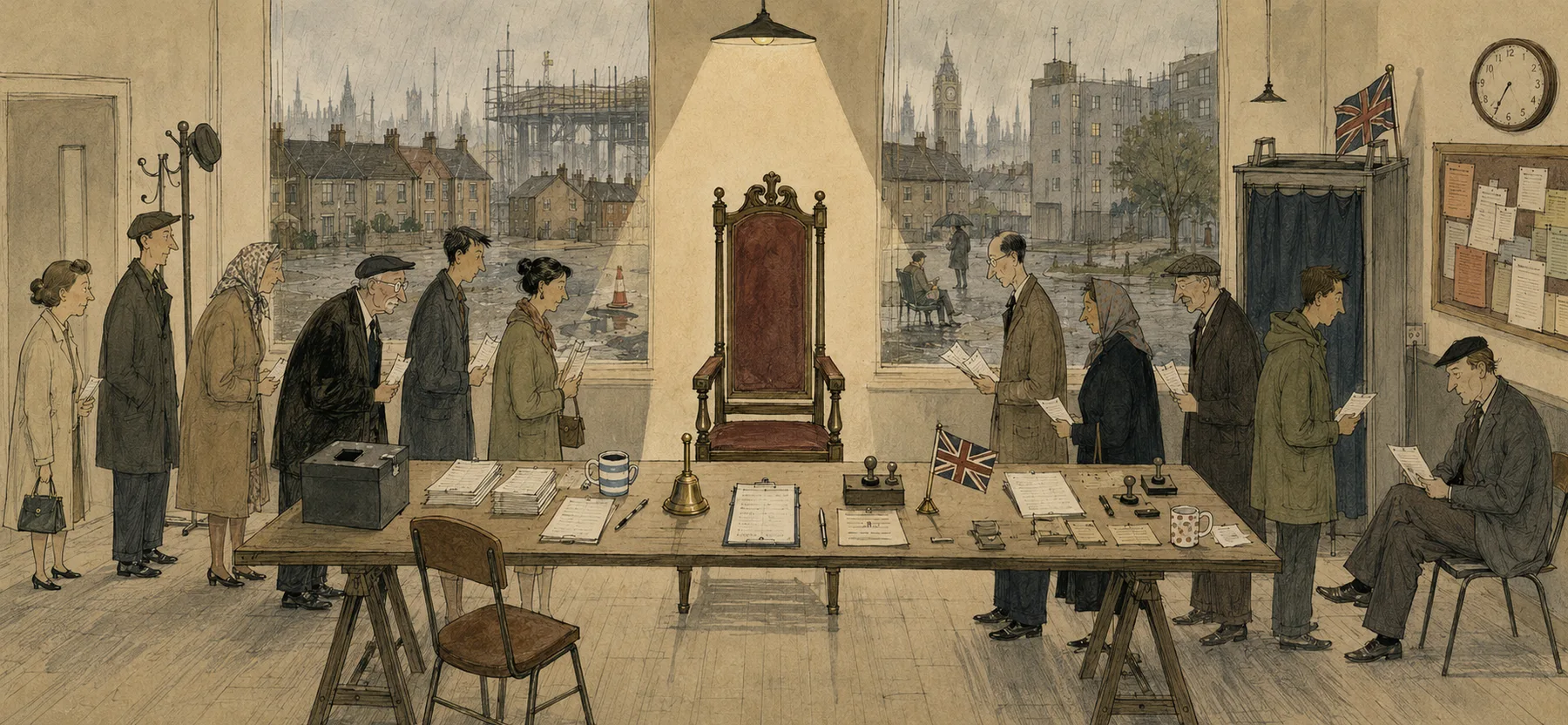
British politics has started to feel like a tenants’ WhatsApp group after the landlord stops replying. Everyone is typing. The damp is spreading. You vote, and the government changes. The rent does not. The waiting list does not. The pothole outside your house is still there. And it begs the question. Who is in charge?
This is something structural and troubling: a growing suspicion, across the political spectrum, that democratic participation has become formally intact and practically hollow. We go through the motions - campaigns, manifestos, debates, results, transitions of power - and the things people actually care about remain, stubbornly, the same.
The question worth asking is not whether this suspicion is irrational. It is whether it is correct.
The Old Bargain
Democracy was not supposed to be complicated. The basic contract was simple, if imperfect.
You vote. The government changes. The new government does different things. Those things affect your life. You judge them. You vote again. Power circulates. Mistakes get corrected. The governed have leverage over the governors, and everyone knows it.
This model was never pristine. It excluded people, entrenched interests, resisted reform, and produced plenty of governments that managed more than they governed. But it had a coherent logic. Elections meant something because the people who won them could actually do things. The chain between voting and what changed was visible, if not always reliable.
That chain has not snapped. But it has stretched to the point where many people can no longer see where it connects.
You vote, but housing remains impossible to afford for a generation of people who did everything right. You vote, but waiting times in the health service have not returned to anything like their pre-pandemic levels in a decade. You vote, but the infrastructure project you were promised is still in a planning inquiry, and the pothole outside your house has outlasted three ministers and the manifesto that promised to fix it. You vote, and the economic conditions that shape whether your wages are worth anything seem to have been decided in Frankfurt, or Washington, or by a bond market that has its own views about what governments are allowed to do.
This is not a left-wing or right-wing observation. It is structural.
Trust Is Not a Mood
Trust in government has been falling, and it is falling in ways that look less like irrational anger and more like a considered conclusion.
The OECD found that only 27% of people in the UK reported high or moderately high trust in national government in 2023 - below the OECD average of 39%, and down sharply since 2021. A 2025 briefing from the UK Parliament noted that between 2014 and 2024, the share of people with low or no trust in MPs rose from 54% to 76%. That is not a blip. That is a decade-long verdict.
The important thing about these figures is what they do not show. They do not show people who have become nihilists, or who have abandoned belief in collective solutions. They show people who have formed a reasonable assessment that the institutions asking for their trust are not delivering what they promised, and who have updated their trust accordingly.
This is not necessarily a crisis of irrationality. It may simply be people noticing what is in front of them.
Britain as Stress Test
Britain is a particularly useful place to think about this problem, because it combines a great deal of formal democratic prestige with a great deal of practical political dysfunction.
The country has sovereignty, a nuclear arsenal, world-class universities, a global financial centre, a permanent seat on the UN Security Council, and a political class that still speaks in the cadences of a country that once administered a third of the world. The constitution is uncodified and flexible by design, meaning that - in theory - a government with a parliamentary majority can do almost anything.
In practice, it often cannot build a railway on time or on budget. It cannot house its young people. It cannot staff its hospitals at the wage levels it can afford to pay. It cannot regulate utilities in a way that produces either efficient markets or reasonable bills. It cannot admit that planning law is the single largest constraint on the country’s economic geography and act accordingly. It can barely fill a pothole without a procurement process.
This is not a partisan observation. It has been true under Conservative governments, Labour governments, and every shade of managed disappointment in between. It is a structural observation: that the machinery of British government has become less capable of converting democratic mandates into visible delivery, even as the volume of political rhetoric about delivery has increased dramatically.
The gap between what is said in political campaigns and what demonstrably happens is the engine of the decline in trust. When that gap is consistent enough, for long enough, across enough domains, people stop believing the campaign and start believing the gap.
The Technocratic Answer, and Why It Fails
When democracies get into this kind of trouble, there are roughly two answers on offer.
The first is technocracy. Replace the flamboyant incompetence with quieter, more sophisticated management. Put economists in the Treasury who know what they are doing. Give regulators proper teeth. Depoliticise monetary policy. Commission independent reviews. Build a civil service capable of executing complex programmes. Attract talent from the private sector. Measure outcomes. Hire people who understand delivery.
This answer is not wrong. It is simply insufficient.
State capacity matters. It matters enormously. You cannot build houses, staff a health service, or decarbonise an energy grid without institutions that know what they are doing. Countries that have maintained functional public services - most of the Nordic states, much of northern Europe, parts of east Asia - have done so in part because their administrative capacity did not atrophy through decades of outsourcing, reorganisation, pay compression, and political contempt for public servants.
But competence is not the same as legitimacy. A democracy cannot mean only replacing loud failure with quiet competence. A country is not a consultancy deck. People need not only service delivery, but agency, dignity, voice, and a sense that the future is being shaped with them rather than administered on their behalf.
Technocracy can repair the machine. It cannot tell us where to drive it.
The managed disappointment problem - which is the specific British version of this failure - is precisely that technocratic language has been adopted not to produce better outcomes, but to insulate decision-makers from accountability for the outcomes that exist. The rhetoric of evidence-based policy, of complex trade-offs, of independent review, has increasingly functioned as a buffer against responsibility. When nothing is a political choice, nothing can be politically judged.
That is a corruption of the technocratic idea, but it is an entirely predictable one. Expertise deployed in the service of accountability avoidance is not expertise in any meaningful democratic sense.
The Populist Answer, and Why It Also Fails
The second answer is populism. Return power to the people. Sweep away the experts, the bureaucrats, the cosmopolitan elites who don’t understand ordinary life. Restore the authentic national will.
This answer touches a real wound and then treats it with theatre.
The populist diagnosis is essentially correct: democratic institutions have, in many cases, been captured by interests that do not represent the majority, and the distance between official politics and ordinary experience has become a scandal. The anger that powers populist movements is not manufactured. It is not the product of manipulation alone. It reflects a genuine collapse in the feeling of shared political agency.
But the populist prescription fails for a structural reason that no amount of charisma can overcome: “the people” are not one person.
They are millions of people who live in different economies. They live in different cities and post-industrial towns, in the south-east and the north, in the gig economy and in stable employment. And they have different needs, different values, and different ideas about what collective life should look like. Invoking “the people” as a unified sovereign will is a way of resolving, rhetorically, conflicts that can only be resolved politically, through the messy and irreducible process of democratic argument, compromise, and accountability.
When a political movement claims to speak for the people as a whole, what it almost always means is that one faction has decided it speaks for the nation, and that those who disagree are therefore not really of the nation. That logic does not produce democratic renewal. It produces a different kind of democratic closure, one that is worse because it mistakes certainty for legitimacy.
Populism starts from a genuine failure of representation. Its mistake is to treat anger as proof of authority.
Where Power Actually Sits
Once you have set aside the insufficient answers, you are left with the proper question.
Not left or right. Not more state or less state. Not which party. The deeper question is: at what scale should decisions be made, by whom, with what authority, and how can ordinary people actually see the consequences of their participation?
This question immediately opens into territory that electoral politics tends to avoid, because it requires admitting that some of the most consequential decisions affecting British people’s lives are not made by British politicians at all.
Monetary policy is set by the Bank of England, with significant independence from democratic control. Trade conditions are shaped by international agreements that take decades to renegotiate. Energy prices are determined by commodity markets with their own logic. Technology platforms that intermediate public discourse are regulated, where they are regulated at all, in ways that barely touch their actual power over public life. Planning decisions that determine where people can live, and therefore what their economic lives look like, are made through a system so fragmented that even determined governments cannot move it at any useful speed.
None of this is a conspiracy. Most of it reflects genuine complexity. Some of it reflects very good reasons for insulating certain decisions from electoral cycles. But the cumulative effect is that the perimeter of democratic politics has shrunk, without anyone deciding to shrink it, and without any honest reckoning with what that means for the democratic contract.
The question is whether that perimeter can be expanded again - and if so, where.
The possible answers are familiar enough: stronger local government, more serious devolution, citizens’ assemblies for questions too long-term or too captured for normal party theatre, electoral reform, and above all state capacity. But each of these belongs to the next question rather than this one. Before asking how democracy might be repaired, we have to name the thing that has broken: the link between participation and consequence.
Democracy as a Muscle
The conclusion is not that democracy is doomed. Democracy has survived worse than this. It has survived mass warfare, economic catastrophe, and the specific British talent for treating every problem as a reason to form a committee and defer a decision.
But democracy can fail in a new way that has no dramatic name: not with a bang, or even with a whimper, but with a shrug. The gradual discovery that participation does not produce change. That voting is a ceremony, not a mechanism. That the system is formally open and practically closed.
That is the specific failure worth worrying about. Not that the wrong party is in power. Not that the media is too sensationalist, or voters too credulous, or politicians too venal, though all of these may be true. But that the basic democratic proposition - that collective choice can shape collective life - has become harder to believe, not because the proposition is wrong, but because the machinery for making it true has been allowed to weaken.
Democracy is a muscle. It atrophies if unused. It weakens if the weights are always removed before they get heavy. It needs exercise that is visible and consequential - decisions that feel real, made by people who are genuinely accountable, in institutions capable of delivery.
The question is not whether democracy can survive anger. It has survived plenty of that. The harder question is whether it can survive becoming abstract: something people are asked to perform, but no longer expect to work.
People will tolerate losing arguments. They will tolerate compromise. They will even tolerate politicians, in moderation. What they will not tolerate forever is the feeling that public life has become a ceremony of consent for decisions taken without them.
If voting stops changing people’s lives, people will not give up on change. They will simply start looking for it elsewhere.
The data version of this argument — trust series, comparative institutional design, and four maps of actual policy machinery — is in The Consent-Control Gap.